In 20 Years of Styling Homes
I have noticed a pattern that never changes. Clients spend months agonising over the living room — the sofa, the rug, the gallery wall. They pour creativity and budget into the kitchen, the hallway, even the bathroom. And then, almost as an afterthought, they turn to the bedroom. ‘We’ll sort that out eventually,’ they say. The spare duvet goes back on. The flat-pack bedside table stays. The overhead light remains.
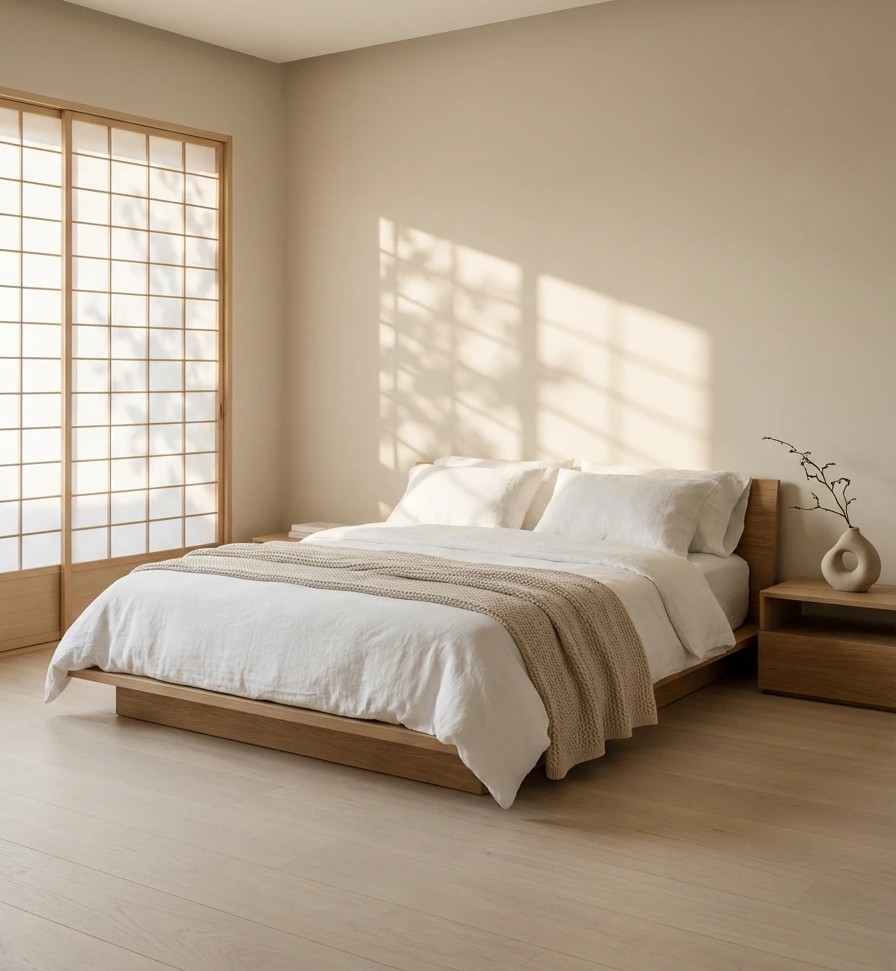
I understand the logic. The bedroom is private — no one else will see it. But that’s exactly why it matters more than any other room in your home. You spend roughly a third of your life in your bedroom. The quality of what you see the moment you open your eyes, and the last thing you process before you fall asleep, has a measurable effect on the quality of your sleep, your morning mood, and your overall sense of wellbeing. This is not interior design philosophy. This is neuroscience.
Japandi — the fusion of Japanese minimalism and Scandinavian warmth — happens to be the design language most perfectly aligned with what the brain and body need from a bedroom. Not because it looks beautiful (though it does), but because of how it makes you feel. In this guide, I’m going to show you how to build a Japandi bedroom from the inside out — starting not with the furniture, but with the philosophy.
What Your Brain Actually Needs From a Bedroom
Sleep scientists and environmental psychologists have spent decades studying how our surroundings affect our ability to rest. The findings are consistent and, for anyone who has ever lain awake in a cluttered bedroom, completely unsurprising: visual complexity raises cortisol. Cool, blue-toned light suppresses melatonin. Hard, reflective surfaces increase alertness. Clutter creates unconscious cognitive load — your brain registers every unfinished task, every displaced object, and processes them as low-grade stressors even as you try to sleep.
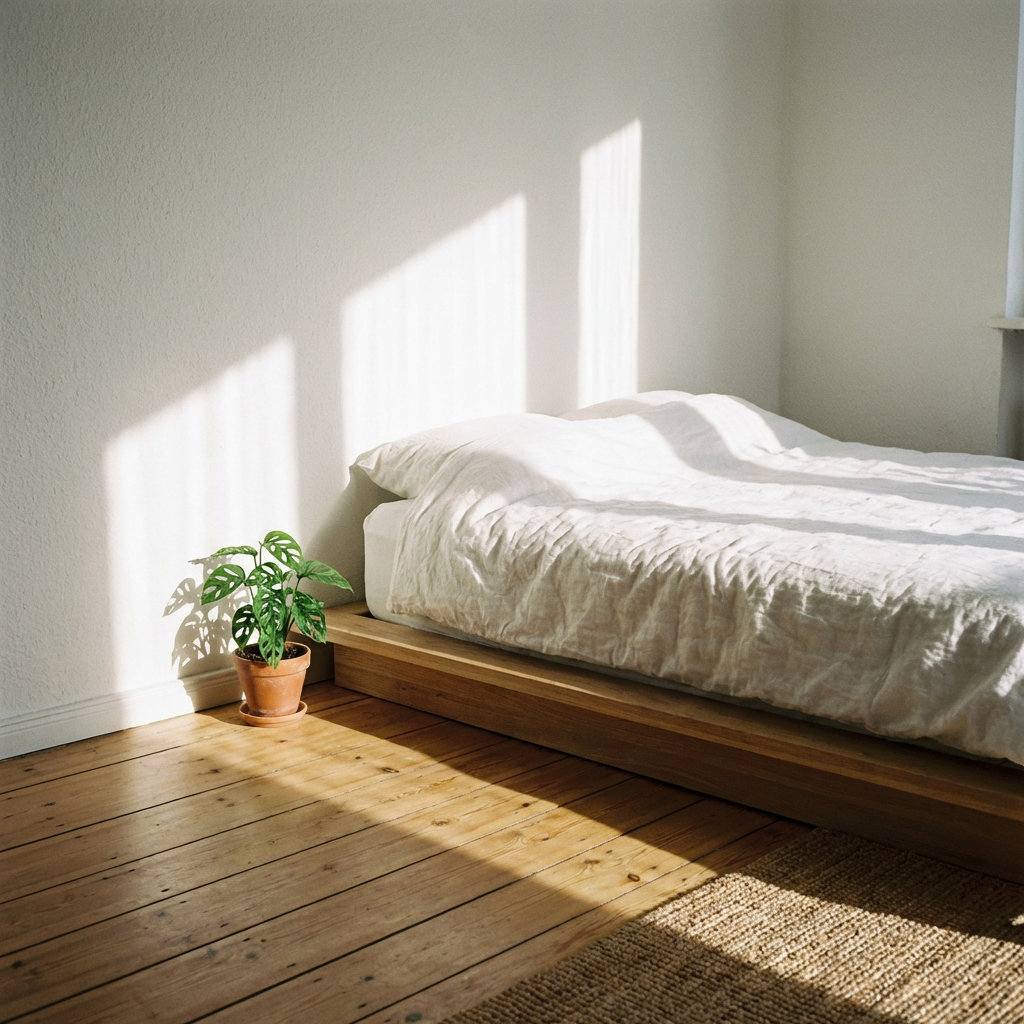
“Every object visible from your pillow is a message your brain receives at midnight.”
Japandi addresses all of this with remarkable precision. The warm, earthy palette calms the nervous system. The low furniture and uncluttered surfaces reduce visual complexity. The natural materials — linen, wood, wool, ceramic — engage the senses softly rather than sharply. The philosophy of ma (deliberate negative space) ensures that the eye always has somewhere to rest. Designing a Japandi bedroom is, in the most literal sense, designing for better sleep.
Ma: The Japanese Art of Leaving Space
The concept of ma is one of the most misunderstood ideas in Japanese design. It is usually translated as ‘negative space’ or ’emptiness’, but that translation misses the point. Ma is not the absence of something. It is a presence in itself — a pause that gives meaning to everything around it, the way silence gives music its power.
In the bedroom, ma looks like this: a bedside table with one lamp and one small ceramic object, and nothing else. A wall with a single piece of art, and 80% of beautiful bare plaster around it. A floor that is largely clear, where the texture of the floorboards or the grain of a single rug can be truly seen and appreciated. A dresser top with three objects, spaced deliberately, rather than an accumulation of bottles and trinkets.
Practising ma in your bedroom will feel uncomfortable at first, if you’re used to filling space. We are conditioned to believe that empty space means an unfinished room. Japandi asks you to reverse that instinct entirely — to see the space itself as the most valuable thing in the room, and to place objects only where they genuinely earn their presence.
A Practical Exercise: The One-Week Edit
Before buying a single new thing for your bedroom, try this: spend one week removing items. Take everything off surfaces. Put non-essential furniture in another room. Live with the resulting emptiness and notice how it feels. Then, very slowly, bring back only what you genuinely miss — and only in its ideal form. What remains will be your Japandi bedroom.
Colour in the Japandi Bedroom
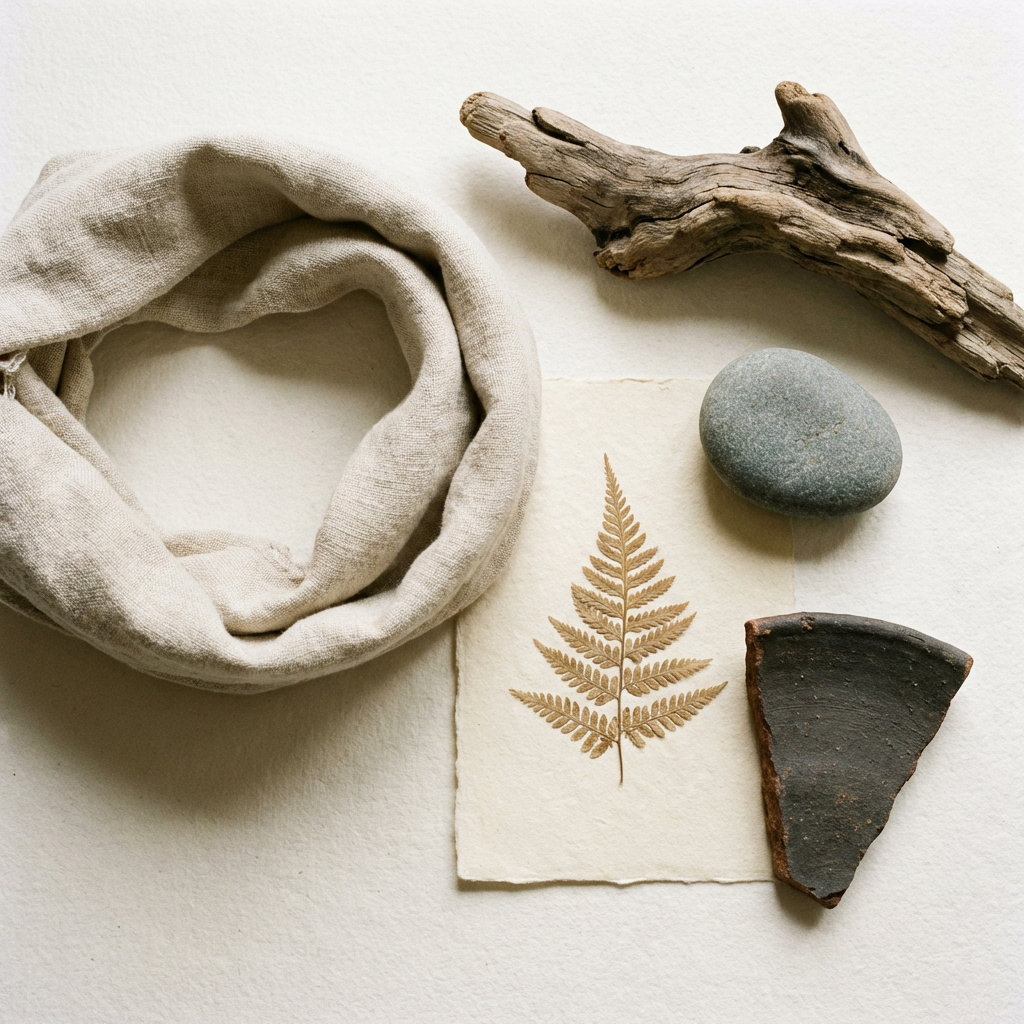
The Japandi bedroom palette is quieter and more introspective than any other room in the house. Where the living room might carry a note of sage or terracotta as an accent, the bedroom retreats even further into the understated. Here, the palette almost whispers.
The Foundation: Undyed and Undiluted
Think of the most calming natural environments you’ve ever experienced — a birch forest in winter, a sand dune at dusk, a pebble beach under overcast sky. The bedroom palette borrows from these moments. The dominant tones are warm whites that lean towards cream, soft greiges that sit between grey and sand, and the natural colour of wood left unsealed.
Accents: Ink, Clay, and Moss
Where the Japandi bedroom introduces colour, it does so with the restraint of a haiku. A single charcoal-inked linen cushion. The dark glaze of a ceramic lamp base. A dried botanical in dusty sage or faded terracotta. A knitted throw in the colour of damp clay. These accents are never bright, never saturated, never more than two per room.
The One Rule on Cool Colours
Never introduce a cool tone — a blue-grey, a stark white, a silver, a glass surface — into a Japandi bedroom. Cool tones are neurologically alerting. They register as ‘daylight’ to the brain and work against the melatonin signals your body needs to sleep. Every colour decision in your bedroom should ask: does this warm the space? If yes, it belongs. If not, it does not.
The Bed Is Not Just Furniture. It Is a Daily Ritual.

In Japan, there is a practice called seiri — the art of putting things in order. Making the bed in the morning is not a chore; it is a micro-ritual that sets the tone for the entire day. Psychological research backs this up: people who make their beds consistently report higher productivity, better mood, and crucially, better sleep quality at night.
The Japandi bed is made beautifully but not perfectly. This is important. Linen is chosen precisely because it wrinkles naturally and looks more beautiful for it — a living example of wabi-sabi, the acceptance of imperfection as part of beauty. You are not creating a hotel bed. You are creating a human one.
The Bed Frame: A Foundation, Not a Statement
Choose a platform bed or a low-slung frame in solid wood — oak, ash, or walnut. The headboard should be simple: a solid panel, a gently slatted back, or no headboard at all in favour of a clean wall. The bed sits low because it grounds the room, reduces the visual height of the space, and — in the Japanese tradition — acknowledges our relationship to the floor as a place of rest.
The Bedding Hierarchy
This is where your budget should go, full stop. Invest in 100% linen — it is the most Japandi fabric imaginable. It is the only textile that looks better unwashed, wrinkled, and worn. It is temperature-regulating, hypoallergenic, and extraordinarily durable. Buy the best linen duvet cover and pillowcases you can afford, in warm white or undyed natural, and layer with a waffle-weave cotton blanket or a merino wool throw at the foot of the bed.
Light Before Dark: Designing Your Bedroom for Both Day and Night
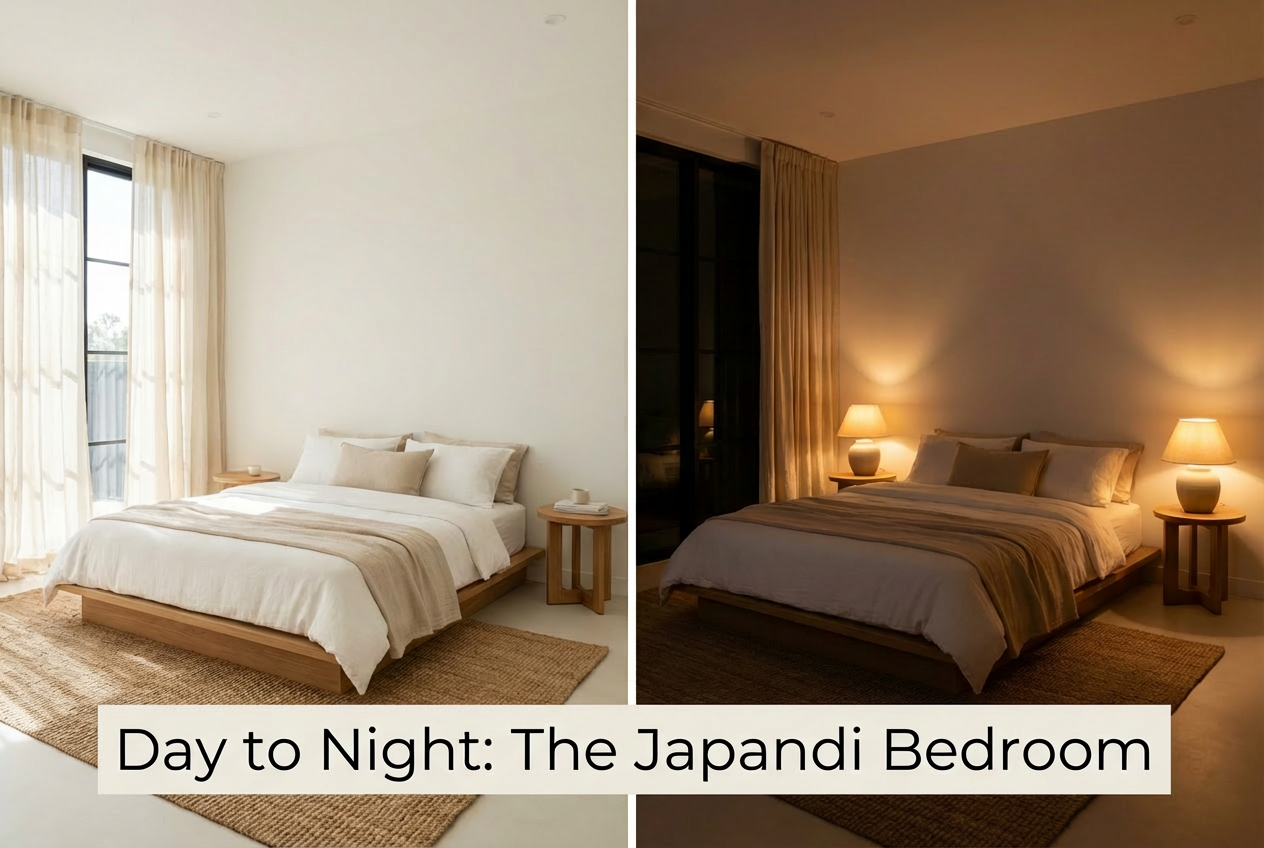
A truly well-designed bedroom performs completely differently at different times of day — and in a Japandi space, that transformation is deliberate and beautiful. The same room that is flooded with healing morning light becomes a warm, lamp-lit cocoon in the evening.
Designing for Daylight: The Morning Reset
Maximise natural light during the day. Hang sheer linen panels that filter light to a warm, diffused glow rather than blocking it. If possible, orient your bed so that morning light falls across it — waking to natural light is one of the most powerful regulators of the circadian rhythm.
Designing for Night: The Wind-Down Ritual
For evenings, the bedroom should have zero reliance on overhead lighting. Two ceramic or wooden bedside lamps at a low wattage (warm white, 2700K or lower, ideally on dimmers) create the soft, enveloping light that signals to the body that sleep is approaching. Layer in a candle or two — beeswax or unscented soy, in a ceramic or stone vessel. The combination of warm lamplight and candlelight is the most neurologically soothing environment a bedroom can offer.
The Japandi Bedroom and the Technology Question
“The bedroom is the one room in the house that technology has not yet earned the right to occupy.”
The television in the bedroom is incompatible with Japandi design — and with restorative sleep. A screen mounted on the wall opposite the bed is a visual anchor that dominates every sightline in the room, even when it’s off. It introduces a hard, reflective surface into a space that needs warmth and softness. And it signals to the brain, every time you enter the room, that this is a space for stimulation rather than rest.
The same applies to phones on the bedside table, tablets propped against pillows, and laptops balanced on knees. Japandi is not a Luddite philosophy, but it is an intentional one. The bedroom, in the Japandi worldview, is sacred space. Everything that enters it should earn its place by contributing to rest, beauty, or genuine human connection.
What Replaces the Screen
A beautiful bedside stack of two or three books — real books, with tactile covers — is the Japandi alternative to the bedside scroll. A small ceramic tray for a journal and pen. A simple alarm clock in wood or matte metal so that the phone stays outside the room entirely.
Scent as Architecture: Building Your Bedroom’s Invisible Layer
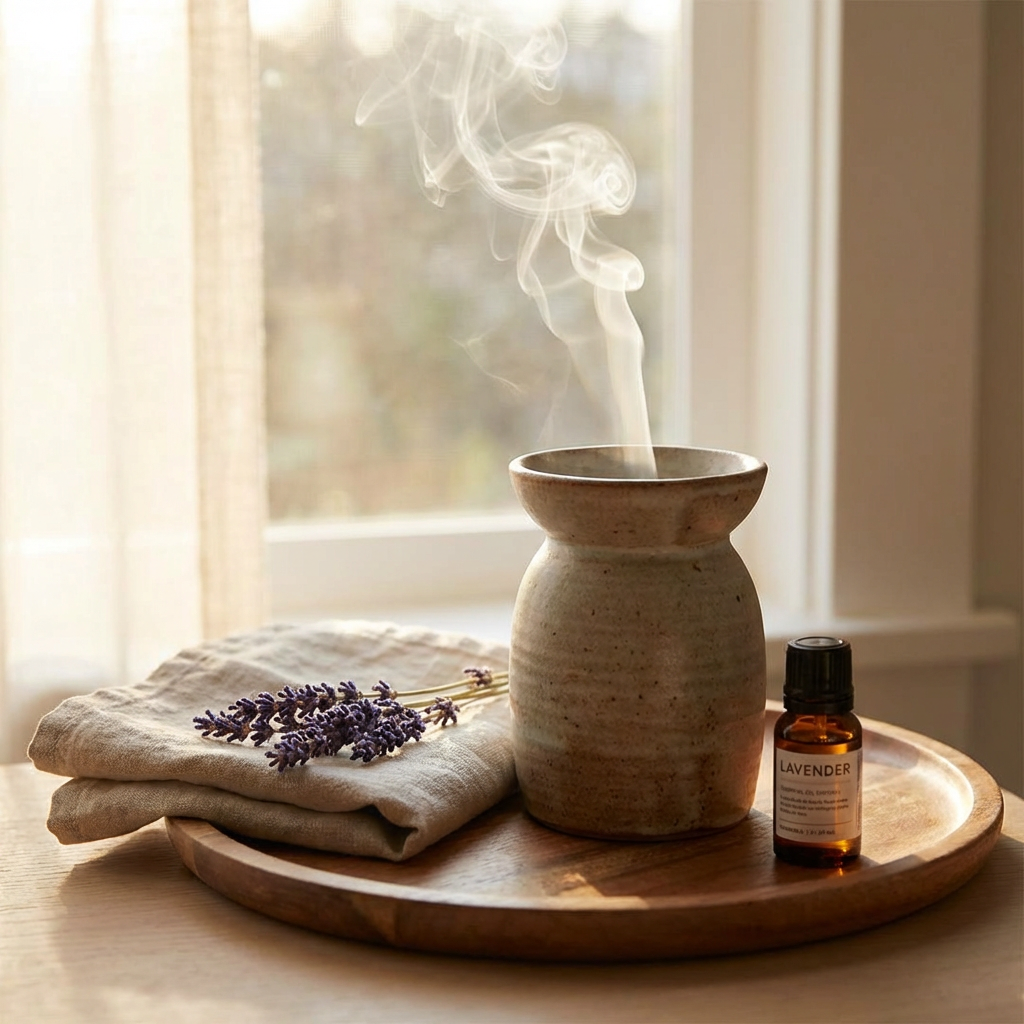
Scent is processed by the limbic system — the part of the brain that governs memory, emotion, and the nervous system response. The right scent in the bedroom can reduce cortisol, lower heart rate, and meaningfully improve sleep onset time. In a Japandi bedroom, scent is not an afterthought. It is part of the architecture.
The Japandi bedroom scent vocabulary: hinoki cypress (grounding, woody, profoundly calming), yuzu (bright but gentle, like morning citrus filtered through linen), sandalwood (deep and warm), lavender and chamomile (the sleep-science classics), and white tea (clean, cool, and utterly serene).
Plants in the Japandi Bedroom: Quiet Companions for Better Sleep
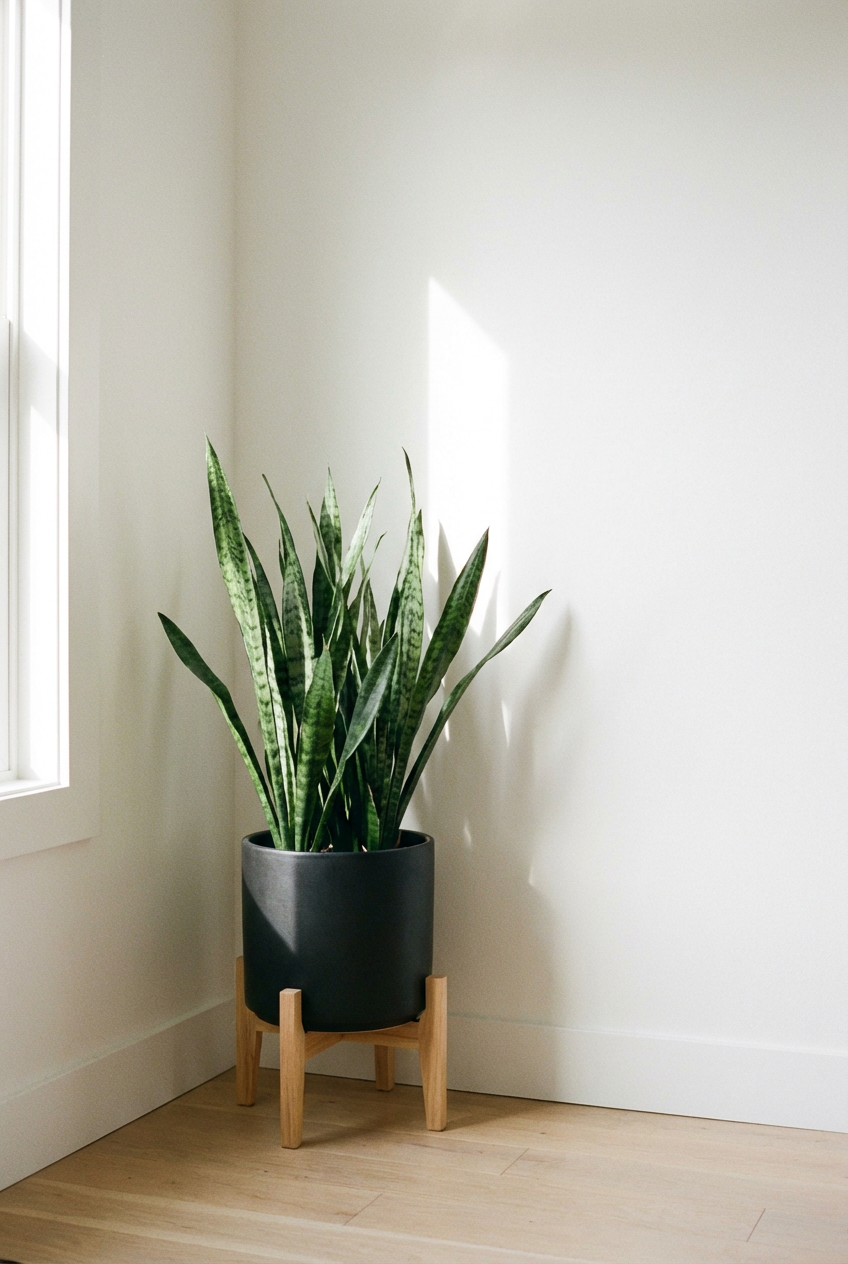
Plants are not decoration in Japandi; they are structural elements. They bring organic life into a space that might otherwise tip into sterility, and they create a sense of growth and impermanence that is central to wabi-sabi.
For the bedroom, choose plants that thrive in lower light and have a calm, architectural quality. The snake plant is without peer: it releases oxygen at night, tolerates low light, requires watering only once a fortnight, and has a beautiful sculptural form. A small ZZ plant on the dresser. A trailing marble pothos on the bedside table. A single orchid in a ceramic pot on the windowsill.
The Floor: The Most Underrated Element of a Japandi Bedroom
In a room with low furniture and deliberate negative space, the floor is highly visible — and what you put on it (and what you leave off it) matters enormously. Natural wood flooring is the ideal Japandi bedroom floor: warm, organic, and beautiful in its grain and variation.
The Rug as Ritual Object
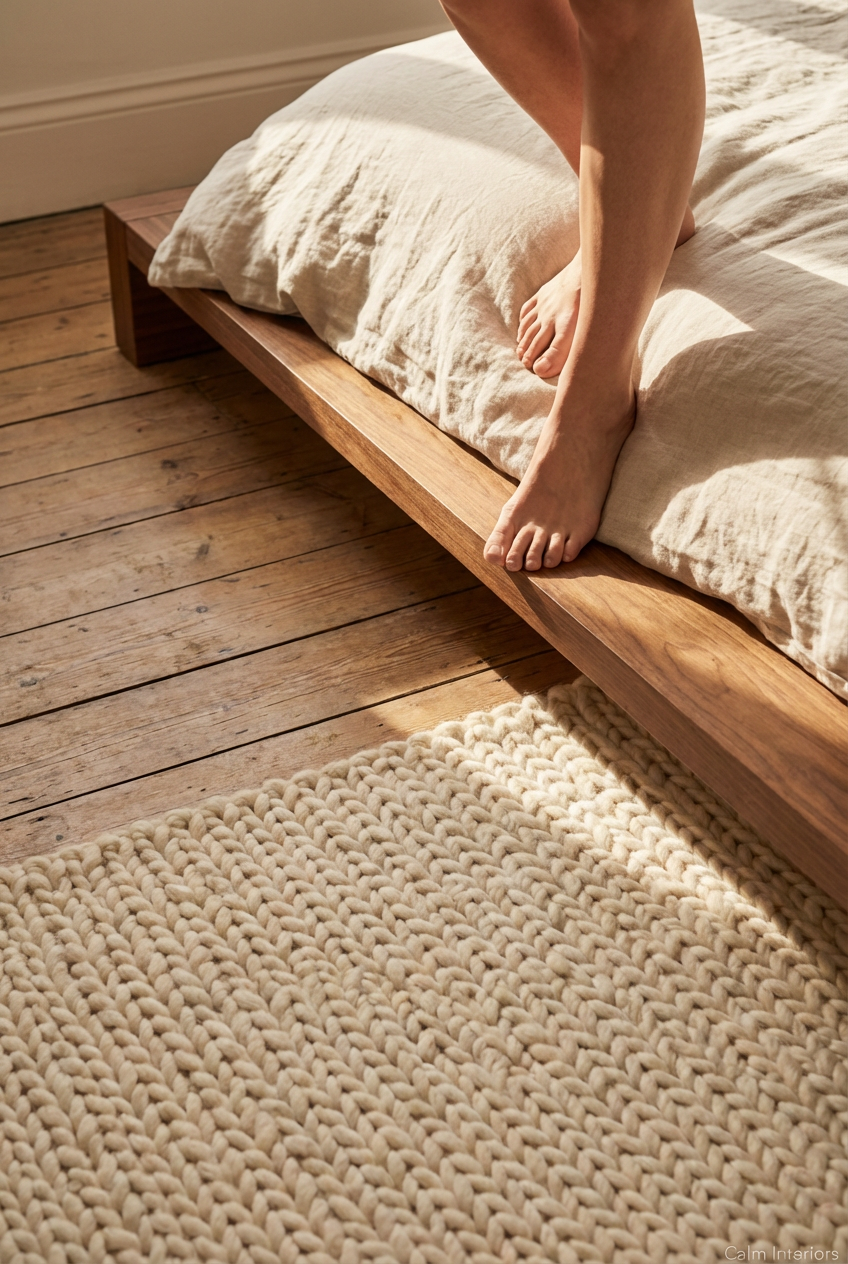
The rug beside the bed is the first thing your bare feet touch every morning. In a Japandi bedroom, that moment should be a small sensory pleasure — the gentle resistance of a wool loop pile, the warmth of a thick jute weave, the nap of a Moroccan Beni Ourain in undyed natural wool. Place the rug so that both sides of the bed are covered — you should never step onto cold floor first thing in the morning.
The Japandi Bedroom Through the Seasons
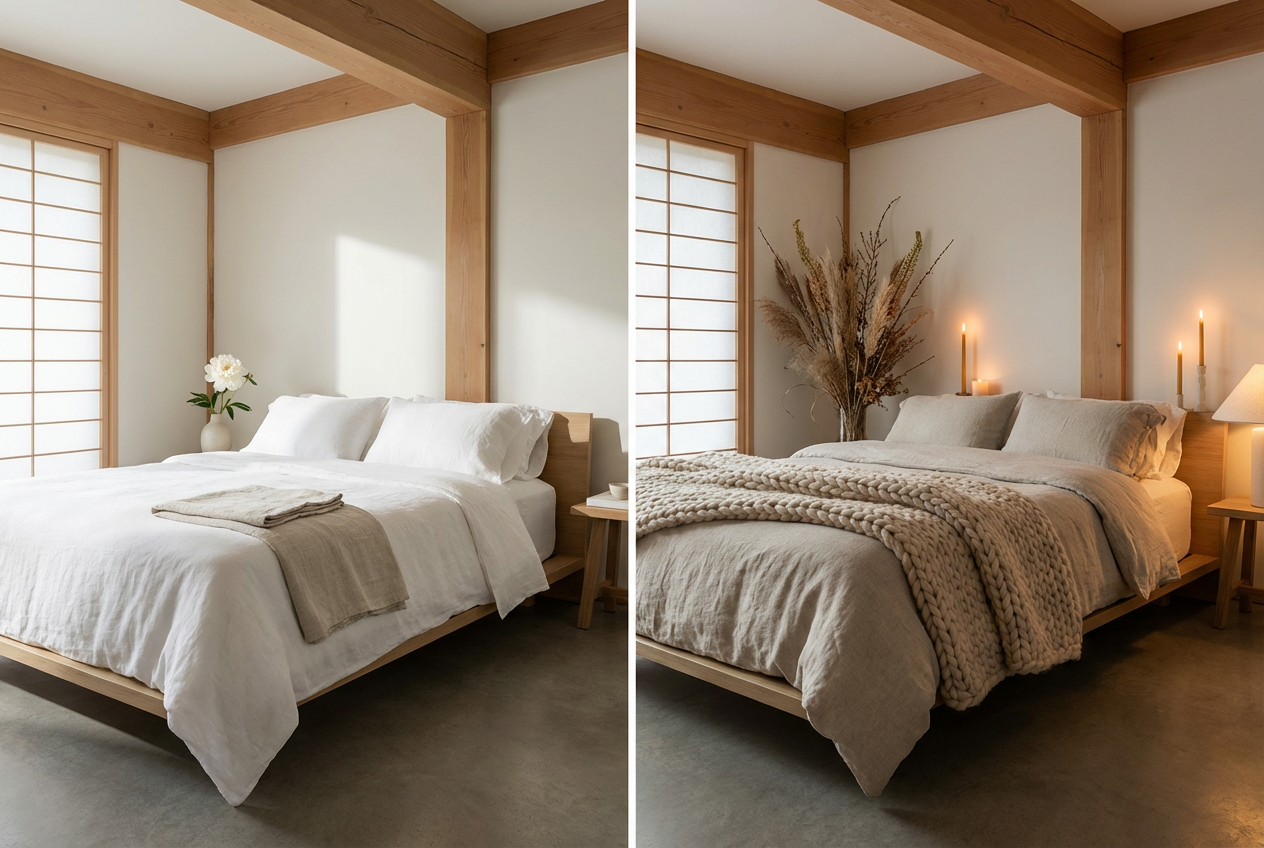
In spring and summer: strip the bed back to a single linen sheet and a light cotton waffle blanket. Swap heavy curtains for sheers. Bring in fresh flowers or a single trailing plant. The palette lightens — more white, more natural undyed linen, less layering.
In autumn and winter: add weight and warmth. A heavier merino wool or linen duvet insert. A chunky knit throw in oatmeal at the foot of the bed. Swap out dried botanicals for seasonal finds — a branch of dried copper beech leaves, a few stems of dried cotton plant. Light the candles earlier. The bedroom becomes a den: the hygge version of itself.
Begin Tonight
Tonight, before you sleep, try this: remove everything from your bedside table except your lamp. Put your phone in another room. Light a candle. Pull back the duvet and look at your bed as an object — notice whether it invites you to rest, or whether it’s just there. Tomorrow morning, when you wake, notice how the room feels with those small changes.
That noticing — that sensitivity to your environment — is the beginning of designing a Japandi bedroom. It does not require a renovation budget or a blank slate. It requires attention. The willingness to ask, of every object in your bedroom, whether it earns its place in the most intimate room in your home.
The Japanese have a phrase: ma no bi — the beauty of emptiness. In your bedroom, that beauty is not an absence. It is a presence: the presence of rest, of quiet, of a space that exists entirely for you. Build that space with care, and it will give you something that no other room in the house can: the profound, daily gift of genuinely good sleep.
— Rest well,
Calm Interiors